Smart maintenance / A clue needs context
Fault signals before failures
A warning tells you that a rule has been triggered. Finding the cause requires the signal, the circumstances and the correct diagnostic procedure.
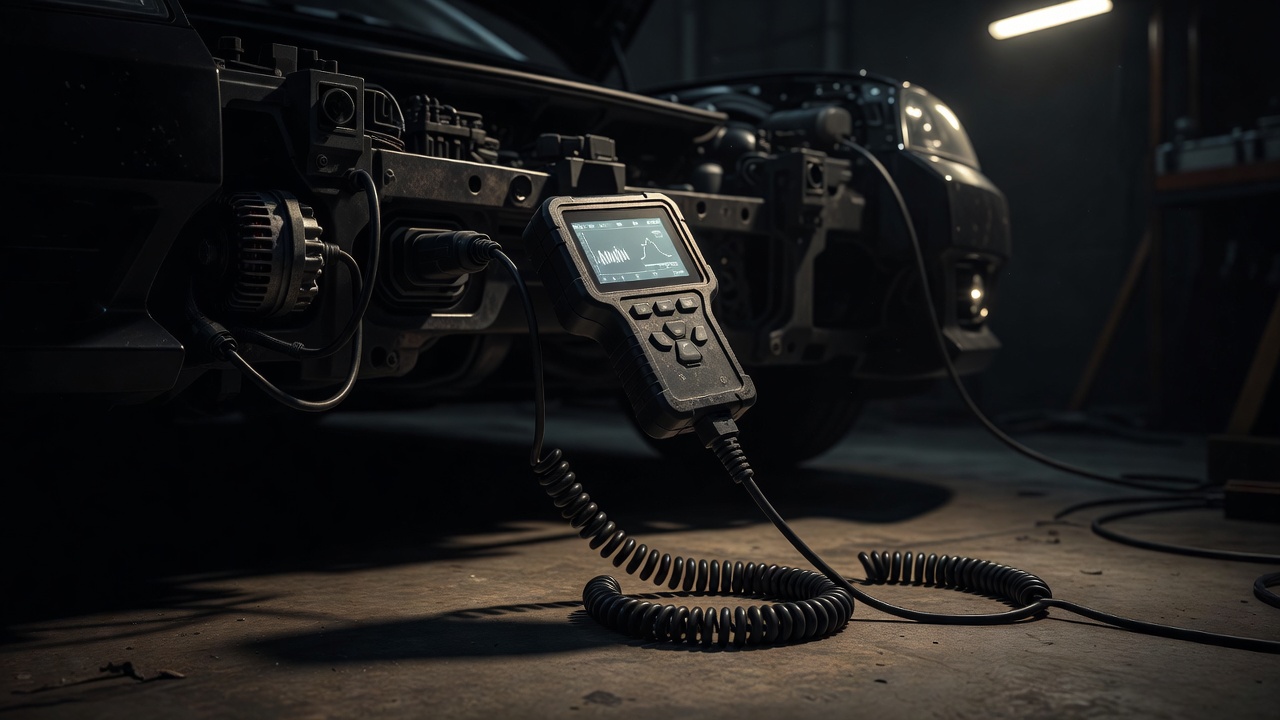
A code identifies a detected condition.
On-board diagnostics monitor selected systems and store information when particular criteria are met. A diagnostic trouble code can indicate an unexpected signal, an emissions-related condition or a communication problem. It does not necessarily identify the component that caused the condition.
A sensor-related code may arise from the sensor, its wiring, a connector, power supply or the physical condition being measured. Replacing the named part without tests can waste money and leave the fault unchanged. A technician may inspect live data, circuit behavior, service information and freeze-frame records captured around the event.
Generic OBD-II readers provide useful access to standardized information, particularly emissions-related data. They may not expose every manufacturer-specific module, fault or test. A low-cost reader showing no codes does not establish that brakes, steering, airbags or high-voltage systems are healthy. SAE J1979 and ISO 15031 are relevant references for standardized diagnostic communication, not guarantees of universal tool coverage.
Urgency comes from the warning and the symptoms.
Record the exact message, warning symbol and circumstances when it is safe to do so. Note whether the engine was cold, the weather was wet, charging had just started or a repair had recently occurred. These details can reveal a pattern that a single stored code cannot.
Read the owner’s manual for the specific action required. A stop instruction, loss of braking or steering assistance, smoke, severe overheating or an apparent electrical hazard requires a safety-first response. Move to a safe location if possible and contact suitable roadside or emergency assistance. Do not continue driving just to see whether a serious warning clears.
Erasing codes is not a repair. It can remove valuable diagnostic context and reset readiness information used in emissions checks. Disconnecting the battery as a general cure can also create new setup requirements. Preserve evidence and seek qualified advice rather than repeatedly resetting the symptom.
Limitation note: why an intermittent fault still matters
A connector may behave normally when dry or stationary but fail under vibration or moisture. A warning that disappears can leave a stored history. Describe the conditions accurately; do not assume absence of a light proves absence of a fault.
Routine monitoring is not a complete inspection.
Direct tire-pressure monitoring commonly uses sensors in the wheels. Indirect systems infer a pressure-related change from wheel behavior and require appropriate initialization. Both have limits. A warning may appear only after pressure has fallen significantly, and neither system replaces regular pressure checks or visual inspection for damage.
Use the vehicle’s specified cold tire pressures, generally found on the vehicle placard or in its manual, rather than treating the sidewall maximum as a normal target. Pressure changes with temperature. Follow the reset procedure after adjustment or wheel work; resetting a warning without correcting pressure can undermine the system’s usefulness.
Oil-life monitors estimate service need using time, distance and, on some vehicles, operating conditions. They do not necessarily measure oil level or directly analyze oil condition. Battery state-of-health reports are also estimates, influenced by measurement method and available history. One reading should not be treated as a precise forecast of remaining service life.
New safety technology still needs physical care.
Camera and radar calibration can be affected by windshield replacement, collision repair, alignment changes or altered ride height. A system that powers on may still need a prescribed calibration procedure. Ask the repairer which manufacturer instructions apply and how completion will be documented.
Electric vehicles avoid some engine-related service items but still need tires, brakes, suspension, cooling systems and other components maintained. Regenerative braking can reduce friction-brake use without removing the need to inspect the brakes. High-voltage systems require appropriately trained personnel and approved isolation procedures.
Predictive maintenance aims to identify a developing problem from patterns in measurements, usage or fleet experience. Its value depends on reliable data and validated thresholds. A prediction can be a useful prompt for inspection, not certainty that a part will fail on a particular day. False alarms and missed faults remain possible.
Road-safety developments such as improved crash structures, automatic post-collision braking and occupant monitoring address different stages of risk. Their presence does not offset worn tires, an unsecured load or an unresolved recall. Check official recall information for your market and vehicle identification number; ordinary maintenance and recall work are different obligations.
| Signal | Useful evidence | Not a substitute for |
|---|---|---|
| Diagnostic trouble code | A monitored condition met fault criteria | Root-cause testing |
| Tire-pressure warning | A pressure-related problem may exist | Pressure and damage checks |
| Service reminder | A time, distance or usage threshold | Investigating new symptoms |
| Battery health estimate | An estimated condition metric | A complete battery assessment |